

Currently Director at Goodfish East Midlands, Andy Hollis is, in the words of Chief Executive, Greg McDonald, a “lifer”, having joined Goodfish in January 2011, within six months of its first acquisition.
As a seasoned senior account manager Andy has a wealth of technical and sector experience and now focusses on delivering excellence in customer service and the commercial aspects of the business – ensuring the best possible understanding of customers’ needs.
Where did it all begin?
I joined Artform International, now known as DCI Artform, in 1997 as a project coordinator. Over 13 years I progressed to senior account manager, gaining invaluable experience of managing blue-chip retail point of sale accounts, including brands such as Boots, Camelot, Nestle, Foster Grant and Gallaher. Retail is constantly changing and throwing up new ideas, so it creates interesting challenges and the need for innovation.
Why Goodfish?
While at Artform, I developed an interest in understanding both injection mould and vacuum forming tooling, which sparked my interest in injection moulding. It was therefore an easy decision to join Goodfish in 2011, during its formative stage, and help Greg to realise his vision for an innovative and integrated Group. In 2014, I was promoted to Commercial Manager at Goodfish’s Cannock facility and after the completion of the outsourcing of DCI-Artform’s injection-moulding and vacuum-forming activities in April 2017, I returned to become Director of our new Loughborough plant. Full circle in fact!
How is it going?
Today Goodfish Group operates from facilities in Cannock, Loughborough and Worcester, where our plastic injection moulding and vacuum-forming businesses also offer printing, second-stage assembly, rapid prototyping and 3-D printing, supported by in-house precision tool-making. Medium term plans include a plant in Slovakia, and with the continued investment in machinery and automation, things are progressing well!
How are you using automation?
Automation, and more specifically robots, are extraordinarily good for consistency, stripping out costs, reducing cycle times and a consistent processing window – but they are not necessarily the whole answer for the small runs required by customers of Goodfish East Midlands. However, we have embraced Single-Minute Exchange of Die (SMED) techniques which is a major contribution to efficiency, reducing waste and minimizing down-time involved in changing from one product to another and we are also looking at minimizing purgings and start up scrap with regrind / recycled material.
What are your interests outside work?
In no specific order – golf, encouraging my boys’ passion for football and patiently restoring an original Austin Rover Mini – Cooper of course!
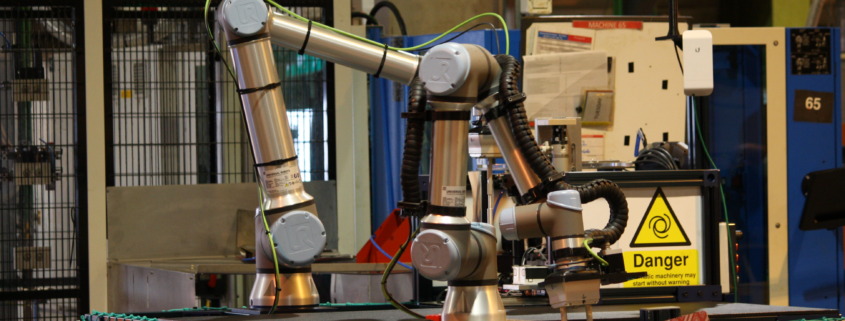
Often placed behind safety cages, requiring specialist programmers to set their tasks and rarely moved, traditional industrial robots are now increasingly being joined by a new generation of lightweight, agile cobots. Short for collaborative robot, cobots are designed specifically to work safely with, not instead of, human beings.
These new mobile, plug and play robots can collaborate safely with human workers due to the latest sensor and vision technology, and for many applications, no coding skills are required. This new wave of robots is set to make hitherto unaffordable levels of automation, available to the smaller companies that make up 70 per cent of manufacturing worldwide.
Speaking of which!
As if to prove there is no limit to what AI, sensors and robots can achieve – watch two robots build an IKEA chair without losing a crucial screw, falling out, or having a cup of tea!
Graduate Scheme
A new intake of graduates will begin their induction this September. But first they will go through our Summer Internship programme in order for us to select the strongest candidates and give them an insight into the world of injection moulding – Goodfish style!
Team Slovakia
Now we have identified our site in Slovakia, we will soon be looking for our team to support our customers operating at the heart of Europe.

A newly commissioned, in-cycle automated hot-foil-printing cell at Powell and Harber in Worcester, is our latest investment in support of our drive to take out rising labour costs and minimise human intervention to ensure standardised repeatable manufacturing conditions.
As the National Living Wage continues to run above inflation, it increases the need to take labour costs out of our processes. Our hot foil printing cell is a fully automated process which for example, prints parts, labels and panels for domestic appliances.
The stability inherent in the automated process improves cost effectiveness through lower waste, higher yields and ultimately a conforming product, on time and in full.

Developing talented individuals, who share our vision and enthusiasm, is central to our culture and growth strategy. We are committed to recruiting and supporting one apprentice and one graduate every year, nurturing them along a fulfilling career path.
Our current apprentice, Owen, spent a year within the business, finding the areas he most passionate enjoyed and is now undertaking a Toolmaker Apprenticeship at In-Comm, who are rated by Ofsted as ‘Outstanding’ and one of the UK’s leading providers of training and business services. Owen will be back in September to spend 3 days a week back in our toolroom at Cannock.
Toyota external apprenticeships
We are looking to recruit another apprentice for the Toyota External Apprenticeship Scheme.
The scheme looks for apprentices who are passionate about engineering and technology, solving problems and who are looking to develop hands-on experience. World-leading trainers will support and guide apprentices on the scheme as they learn skills in welding, machining, hand tool use, electronics, robotics, and much more.
An open evening for potential candidates will be held on 21st March 2018 at Toyota’s Burnaston factory, near Derby.
Seeking graduates with entrepreneurial aspirations
Our new graduate scheme offers a dynamic, enthusiastic and ambitious individual the unique opportunity to learn about the Goodfish Group, from the inside out. Alongside the invaluable mentoring by senior managers and founder Gregory McDonald, the graduate management trainee programme will involve spending six months training and working in each of the following areas:
” QUENSH – quality, environmental, health & safety
” Technical, Quality, Automation & Kaizen
” Team Leader in Mouldshop
” Finance & Supply Chain
” Sales Development
Read more about this opportunity here

Potentially the next significant tech trend to find its way into the manufacturing sector, ‘edge computing’ describes infrastructure which allows data processing and analysis to take place as close to the data source as possible and resolve problems incredibly quickly.
In many environments data loses its value if it isn’t analysed fast enough. Edge computing and analytics have the potential to solve this problem. Devices such as security cameras, smart phones, machine sensors and thermostats all create data, leading to a volume of streaming and sensor data that threatens to overwhelm today’s traditional data analytics tools. Increasingly small and medium sized companies, such as the Goodfish Group, are able to use edge computing to drive quality and service improvements in manufacturing facilities.
Edge computing moves data collection and analysis away from centralised points to the limits of the network, decreasing the volumes of data being moved, the distance data travels and reducing transmission costs. Edge computing also reduces dependency on the core computing environment, removing a potential bottleneck, security risk and a possible point of failure.

In the age of 4IR, manufacturing has become a very exciting place. Ai, Edge Computing, the iIoT, Cyber-Physical Systems and automation are combining to create the “smart factories” of the future. So here is our first ‘bite sized’ guide to the jargon and developments shaping this new world, as we explain just what 4IR means!
According to Forbes we are about to enter Industry 4.0, also known as the Fourth Industrial Revolution “in which computers and automation will come together in an entirely new way, with robotics connected remotely to computer systems equipped with machine learning algorithms”. Meanwhile EEF, the manufacturers organisation believes “the benefits of 4IR technology adoption for manufacturing will be widespread, with smarter supply chains, smarter production and smarter products. Manufacturers will need to keep pace with the change and it will fundamentally change their customers’ expectations”.
At Goodfish, we are assessing new electronic quality management systems and remote machine monitoring, to automate and streamline our business. By adopting 4IR technologies to enable connectivity, flexibility and agility we will be able to significantly increase productivity.